
As a lifelong reader and museum goer, literary historic sites have always had a special place in my heart. In a few days, I’ll finally hit a spot that has been on my bucket list for a long time: Red Cloud, Nebraska, home of Willa Cather.
I first read Cather when I was in high school. I recently pulled down one of those giant 3 books in one books off my bookshelf, and the inscription was from 1993. When I was in grad school, I wrote a paper on literary historic sites, analyzing Red Cloud, Mark Twain’s Hannibal, Thomas Wolfe’s home in Asheville, and Louisa May Alcott’s Orchard House. When I started working with Archer County, home of Larry McMurty, I instantly thought of Cather. Both towns are small and rural. Red Cloud has managed to build a decent tourist economy off of Cather’s legacy. Archer County had that before, with McMurty’s Booked Up store, and now that McMurty has passed, there’s an opportunity to build on that legacy within the proposed county museum. So, the director, a few board members, and myself are headed to Red Cloud to see what we can see–and maybe refine the vision for the future Archer County Museum and Arts Center.
As I was packing for the trip this afternoon, I decided to see if I could find my paper from grad school. The paper holds up pretty well. I know several things have changed in Red Cloud in the last twenty years, but I thought it might be fun to share a few excerpts in advance of our adventures.
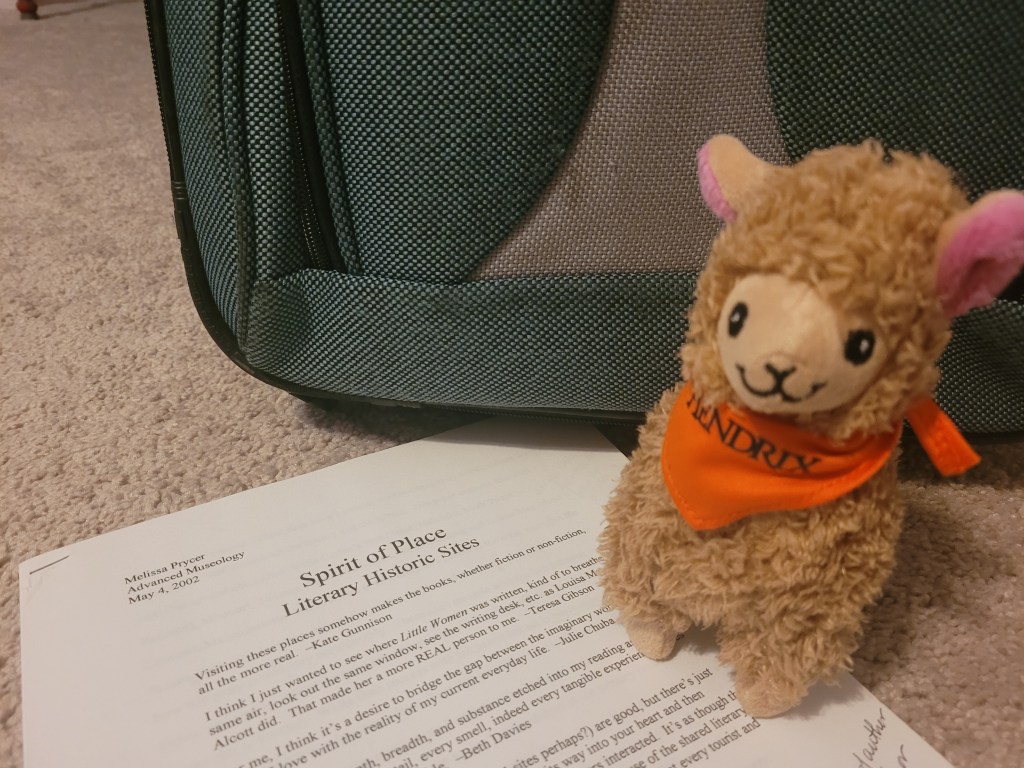
Visitors will journey to the middle of nowhere in Nebraska to see the prairies that Willa Cather made famous in such books as My Antonia and Song of the Lark. Cather is especially known for her stories of immigrant pioneers, struggling against the land and themselves as they try to make a living. . . They are preserving both the buildings and the land that inspired Cather in her Pulitzer prize winning fiction. Red Cloud is a struggling, small town in southern Nebraska where most of the residents are still farmers. Cather is an important industry and just about the only reason why any tourist would visit the town. In fact, the nearest chain motels are forty miles away, so it is not a site for the casual visitor. Curator Anne Billesbach said, “We are definitely off the beaten track so those who come here are very dedicated. You have to know about Cather–and care about her writings–to come here.” Visitors do not simply happen to stop by Red Cloud. Of the approximately 8,000 annual visitors, 75% are already familiar with Cather’s books. Consequently, the site can spend less time introducing Cather and more time on the literary and historical details. . . .
Through its interpretation, the WCPM seems to expect its visitors to be readers of Cather. Her work has not hit mainstream popular culture, but Director Steve Ryan argues that Cather “nonetheless has a wide (if rather quite) following. And most college graduates have read at least a novel or short story of hers. Also, she is a growing favorite among scholars concerned with women’s literature, gender issues, even gay/lesbian studies. We find that our tours and exhibits appeal both to the scholar and causal reader of Cather.” As Ryan defends Cather’s standing in American literature, he also implies that the key to a visit to the WCPM is to be a reader of Cather. With the emphasis placed so heavily on fictional details, the casual visitor may lose interest. Red Cloud is a town that offers much to the Cather enthusiast, but little to the casual visitor that is new to Cather.
When asked about the balance between fiction and history, Ryan answered “We give each equal value. Having properties relating to both helps. In that regard, perhaps more weight is given the fiction–for we have more properties relating to that. But some relate to both. . . One enters both worlds with one visit. The co-existence is inter-penetrative and seamless.” The site seems to see itself as the caretaker of the places and people that inspired Cather’s fiction. The reality of prairie life during the 19th century takes a back to that fictional focus. The text of the state historical marker, written by founder Mildred Bennet, could perhaps be seen as the mission statement that directs this particular interpretive model. Unlike most historical markers, there are no dates; instead, there is mention of literary symbolism, land, the power of one book, My Antonia. Perhaps the last line best sums up the attitude of WCPM: “The history of this land began in the heart of Willa Cather.” With Cather, Red Cloud became more than a tiny spot on the map. However, by focusing so intently on the fiction, Red Cloud does not expand beyond Cather’s legacy.
For this trip, we’ll really be focusing on economic development. However, I won’t be able to stop myself from thinking about the interpretation, especially how they now address Cather’s sexuality. This trip will generate all kinds of food for thought, both for my clients as well as for myself. And it’s only taken me 20+ years to see this literary historic site for myself. Now, off to finish O Pioneers! before I hit the road.
 Prycer Consulting
Leave a comment